Single-Cell Foundation Models
Single-cell biology produced its foundation-model wave between 2022 and 2024. scGPT, Geneformer, scFoundation, scBERT, UCE (Rosen et al., 2026), and tGPT each trained on tens of millions of single cells with the explicit goal of producing general-purpose cell representations that transfer to many downstream tasks. Nicheformer extends the frame by pretraining on both dissociated single-cell and targeted spatial transcriptomics data (Tejada-Lapuerta et al., 2025). The capability is genuine for representation learning, batch correction, zero-shot annotation, and selected spatial-context tasks. Independent evaluations published in 2024 and 2025 (Ahlmann-Eltze et al., Boiarsky et al.) showed that under common metrics such as MSE and Pearson Δctrl, deep perturbation models often fail to beat simple PCA plus linear regression or mean baselines. Miller et al. (Nature Biotechnology, 2026) argue those metrics are frequently miscalibrated (low dynamic-range fraction) and that under well-calibrated metrics (for example WMSE, weighted R²Δ, and normalized inverse rank), deep genetic-perturbation models can outperform uninformative baselines across 14 datasets and 18 metrics. Keep Ahlmann-Eltze as the miscalibration diagnosis Miller answers; do not read Miller as a claim that every deep model beats every linear baseline on every split. The evidence supports scFMs as real tools for parts of single-cell analysis and leaves other claims unverified.
Use this chapter to:
- Distinguish demonstrated representation, integration, annotation, and atlas-search uses from less established perturbation and mechanistic claims.
- Design a task-specific evaluation using biological hold-outs, strong classical baselines, uncertainty, and failure-stratum review.
Prerequisites: Foundation Models for Biology for the general pretrain-then-transfer framework; Evaluation Principles for Life Sciences AI for the biology-aware split discipline.
Summary: Represent cell states, annotations, perturbation responses, and atlas relationships from high-dimensional single-cell data. Single-cell foundation models support useful representations and selected transfer tasks, but independent evaluations show that simple baselines still matter.
Key point: A cell embedding is only as good as the donor, tissue, protocol, batch, species, and label structure behind it. Open question: how much transfer remains after stronger baselines, donor splits, tissue splits, and perturbation tests.
Bottom line: Single-cell models connect molecular regulation to tissues, disease states, systems biology, perturbation biology, aging, neuroscience, and therapeutics.
What is this field trying to solve? Represent cell states, annotations, perturbation responses, and atlas relationships from high-dimensional single-cell data.
What is the core idea? A cell embedding is only as good as the donor, tissue, protocol, batch, species, and label structure behind it.
What is the current state of the field? Single-cell foundation models support useful representations and selected transfer tasks, but independent evaluations show that simple baselines still matter.
What do we know, and what remains open? Known reference points include scGPT, Geneformer, scFoundation, UCE, scBERT, SCimilarity, CELLxGENE, Human Cell Atlas, OpenProblems, scIB, and perturbation datasets. What remains open is how much transfer remains after stronger baselines, donor splits, tissue splits, and perturbation tests.
Why does this matter? Single-cell models connect molecular regulation to tissues, disease states, systems biology, perturbation biology, aging, neuroscience, and therapeutics.
Introduction
Three claims drove the single-cell foundation-model wave between 2022 and 2024: that pretraining on tens of millions of cells would produce useful general-purpose representations, that those representations would transfer to many downstream tasks (annotation, integration, perturbation), and that the resulting models would become the default analytical layer for single-cell biology the way structure-prediction models had changed structural biology.
The first claim is well supported. scGPT (Cui et al., 2024), Geneformer (Theodoris et al., 2023), and scFoundation (Hao et al., 2024) demonstrably produce cell-state embeddings that capture cell type, perturbation context, and developmental state on a wide range of pretraining-similar settings. Nicheformer extends that claim to spatial-context-aware representations by training on a corpus that includes both dissociated and spatially resolved transcriptomics (Tejada-Lapuerta et al., 2025).
The second and third claims are more contested. Independent evaluations published in 2024 and 2025 (Boiarsky et al., 2024; Ahlmann-Eltze et al., 2025) find that on perturbation prediction and several other core tasks, deep approaches often do not consistently outperform PCA plus linear regression under common metrics (Miller et al., 2026, calibrated-metrics update). The infrastructure layer (CZ CELLxGENE, Tabula Sapiens, the November 2024 Human Cell Atlas Nature collection) continues to mature; single-cell foundation models have not yet earned the role of default analytical layer in the same way.
The evidence framework applies to scFMs with particular force: the data scale and the architectural innovation are real, and so is the tendency to overclaim.
Demonstrated capability
Representation learning at scale
The clearest demonstrated capability is general-purpose cell-state representation. Pretraining a transformer on tens of millions of single-cell transcriptomes produces embeddings that:
- Cluster cells by canonical cell type with limited fine-tuning
- Capture developmental trajectories without explicit supervision
- Reflect perturbation state (control vs. treated) in many bulk-scale settings
- Support cell-atlas search (the explicit SCimilarity contribution, Heimberg et al., 2025)
scGPT trained on more than 33 million cells with a generative pretraining objective and demonstrated transfer to cell-type annotation, perturbation prediction, multi-batch integration, and gene-network inference (Cui et al., 2024). Geneformer trained on approximately 30 million cells using a rank-order gene encoding and demonstrated transfer to network biology tasks including dosage-sensitivity prediction (Theodoris et al., 2023). scFoundation extended the scale and added a different pretraining recipe (Hao et al., 2024). scBERT preceded the wave with a smaller pretraining corpus and remains a useful baseline (Yang et al., 2022).
UCE trained on a 36-million-cell corpus spanning eight species and demonstrated zero-shot embeddings and cell-type label transfer in species absent from training, while fine-grained transfer across large evolutionary distances remained challenging (Rosen et al., 2026).
Nicheformer trained on SpatialCorpus-110M, combining dissociated single-cell data with spatially resolved transcriptomics, and evaluated tasks such as spatial composition and spatial label prediction (Tejada-Lapuerta et al., 2025). It should be read as evidence that spatial context changes the representation problem. It should not be promoted to general tissue simulation or perturbation prediction without matched dynamic evidence.
Measured pretraining scaling
DenAdel and colleagues pretrained 400 models on corpora of up to 22.2 million cells and evaluated them across 6,400 model-task combinations. Performance often plateaued before the largest corpus, and the study found no clear data scaling law across the tested architectures, objectives, datasets, and tasks (DenAdel et al., 2026). The result rejects an automatic inference from more cells to better downstream biology. It does not show that additional data cannot help a different architecture, biological distribution, or endpoint.
Cell-atlas search
SCimilarity (Heimberg et al., 2025) reframed the scFM use case from “predict-something-about-this-cell” to “find-cells-similar-to-this-cell” across an atlas-scale reference. The Nature article demonstrated practical search performance at the scale of tens of millions of cells. This is the most defensible production use case for scFMs so far.
SIGnature provides a second bounded use case: feature attribution from single-cell foundation models to rank genes and search gene-signature relationships across studies. Gold and colleagues linked the MS1 inflammatory program to Kawasaki disease and then showed in vitro that patient serum induced the phenotype (Gold et al., 2026). The experimental follow-up strengthens the specific hypothesis. Attribution scores remain model-dependent interpretive outputs, and performance was weaker in tissue underrepresented during training.
scE2TM is an external-knowledge-guided embedded topic model that regularizes topics toward distinct gene clusters (Chen et al., 2026). Across 20 datasets the paper reports stronger clustering and more diverse, pathway-consistent topics than seven comparators; interferon and melanoma case studies are computational topic perturbations and survival associations. scE2TM is an interpretable embedding, not a virtual-cell or treatment model.
Bonsai reconstructs trees over high-dimensional objects to reduce visualization distortion and reports improved nearest-neighbor recovery and known blood-lineage structure, plus a myeloid-derived NK subtype hypothesis (de Groot et al., 2026). Bonsai is distortion-aware tree visualization, not a foundation model or causal lineage claim.
Phenotype association scoring across single cells
He and colleagues describe PASCode, a graph-attention framework that scores how strongly individual cells associate with clinical phenotypes in population-scale single-nucleus RNA-seq. On the PsychAD prefrontal cohort (more than 6 million nuclei from 1,494 donors), the method prioritized microglia and astrocytes for Alzheimer disease association, separated cognitive-resilience contrasts at late Braak stages, and highlighted glial subpopulations shared between Alzheimer disease and depression within that cohort. Pretrained scores transferred to external datasets including SEA-AD, ROSMAP, and a major depressive disorder cohort. Code, pretrained models, and a web atlas are released for community use. PASCode ranks phenotype-associated cells for mechanistic and atlas work. It is not a diagnostic or treatment model for living patients (He et al., 2026).
Integration and batch correction
Pretrained representations transfer well to integration tasks (combining datasets across batches, donors, technologies, and labs). Performance is typically benchmarked against scIB (Luecken et al., 2022), which combines batch-correction quality and biological-signal preservation. scFM methods are competitive with classical methods (scVI, Harmony, Seurat integration) but not uniformly better; the choice depends on dataset size and integration scenario.
The baseline layer is not old infrastructure to skip. Seurat v3 introduced anchor-based integration and label transfer across single-cell modalities (Stuart et al., 2019). Harmony remains a strong shared-embedding method for integrating large single-cell datasets across experimental and biological factors (Korsunsky et al., 2019). scVI and scANVI provide probabilistic latent-variable baselines for representation, harmonization, and cell-state annotation (Lopez et al., 2018; Xu et al., 2021). Any scFM adoption decision should report whether it improves the actual downstream endpoint over these methods, not only whether it improves an embedding visualization.
| Baseline | What It Tests | Why It Matters |
|---|---|---|
| Seurat anchors | Cross-dataset alignment and label transfer | Strong practical baseline for reference mapping |
| Harmony | Shared latent embedding across batch and biological covariates | Fast, widely used, and hard to beat on routine integration |
| scVI / scANVI | Probabilistic integration and annotation | Captures uncertainty and supports downstream differential analysis |
A model-adoption decision path
The model class should follow the decision, not precede it. A single-cell foundation model is a candidate when the intended task, pretraining distribution, and evaluation design align. It is not the default merely because a pretrained embedding is available.
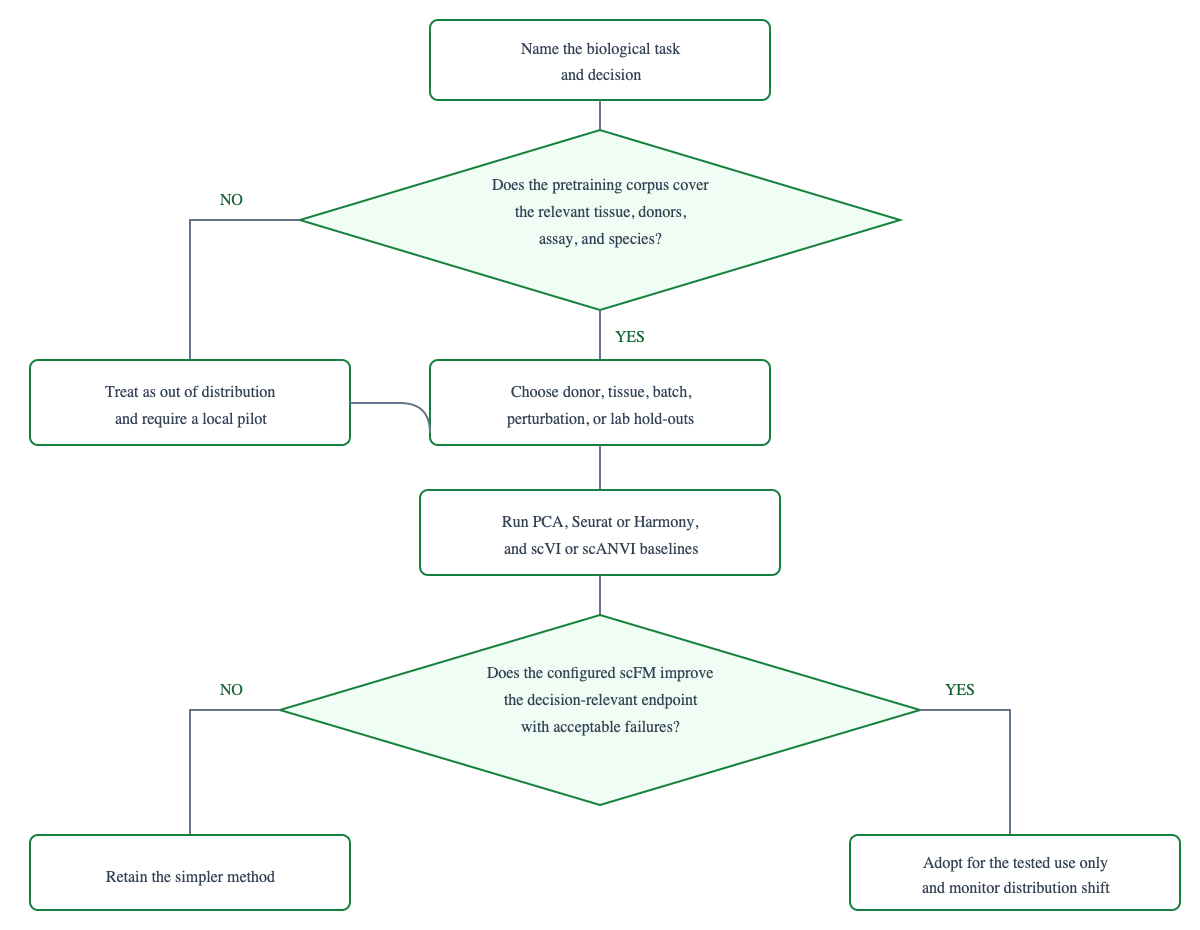
The accompanying record should make the comparison auditable:
| Record field | Minimum entry |
|---|---|
| Intended task | Annotation, integration, atlas search, perturbation prediction, or another named output |
| Decision and unit | The experiment or analysis decision, and whether evaluation is per cell, donor, tissue, perturbation, or dataset |
| Distribution match | Pretraining coverage for tissue, donor, disease state, assay, species, and label quality |
| Hold-out design | Biological axis that must remain unseen at training and tuning time |
| Baselines | Relevant PCA, Seurat, Harmony, scVI, scANVI, or task-specific comparator |
| Decision endpoint | Measure tied to the downstream analysis or experiment, not only an embedding visualization |
| Failure strata | Rare cell types, underrepresented tissues, batches, disease states, and low-confidence cases |
| Adoption boundary | Exact task, data distribution, model version, review date, and condition for withdrawal |
Use the downloadable single-cell evaluation worksheet to preserve these fields across candidate models.
Data infrastructure underneath the models
The model wave depended on the data wave that preceded it:
- CZ CELLxGENE Census (CZ CELLxGENE team, 2023, preprint) provides a large, standardized, queryable collection of curated single-cell observations. Its value as a training source depends on the selected release, tissue, donor, assay, and label coverage.
- Tabula Sapiens (Tabula Sapiens Consortium, 2022) produced 1.1 million cells from 28 organs of 24 donors as a benchmark first-draft human cell atlas.
- Human Cell Atlas (Regev et al., 2017) continues to release organ-specific and developmental atlases, with the November 2024 Nature collection including a roadmap to a unified foundation model (Rood et al., 2025) and several major organ atlases (neural organoids, prenatal skin, thymus, embryonic skeleton).
The data layer’s quality, curation, and metadata determine the scFM ceiling. Pretraining choices about which cells to include propagate to every downstream claim.
Evidence anchor summary
| Evidence Anchor | What It Supports | Practical Constraint |
|---|---|---|
| scGPT, Geneformer, scFoundation | General-purpose cell-state representation at pretraining-similar settings | Out-of-distribution transfer needs separate evaluation |
| UCE | Zero-shot embeddings and label transfer for species absent from training | Fine-grained transfer across distant species remains challenging |
| Nicheformer | Spatially aware cell representations | Spatial context is represented, not simulated dynamically |
| DenAdel et al. 2026 | Direct tests of pretraining-size and diversity effects | No clear scaling law in the tested design; other designs need their own curves |
| SCimilarity | Atlas-scale cell-similarity search | Reference quality bounds search quality |
| SIGnature | Attribution-guided gene-signature hypothesis generation | Interpretation depends on model and training-tissue coverage |
| scE2TM | Interpretable topic embeddings guided by foundation-model knowledge | Clustering and topic diversity; not a virtual-cell or treatment claim |
| Bonsai | Distortion-aware tree visualization of high-dimensional cell states | Visualization and neighbor recovery; not a causal lineage model |
| PASCode | Phenotype-association scoring of individual cells against clinical labels | Prioritization and atlas transfer; not a diagnostic or treatment model |
| CytoVI | Generative modeling of flow cytometry, mass cytometry, and CITE-seq; missing-marker imputation and annotation | Imputed markers are estimates; not a validated diagnostic |
| Integration on scIB | Competitive batch correction | Not always better than classical methods |
| CZ CELLxGENE Census | Standardized aggregated single-cell platform | Curation choices shape downstream transfer |
| Tabula Sapiens 2.0 | 1.1 million cells from 28 organs across 24 donors | Multi-organ atlas, not a population-representative reference |
| HCA November 2024 collection | Continuing organ-specific atlases | Coverage uneven across rare cell types |
Theoretical capability
Several capabilities are plausible but not yet established.
Perturbation prediction at production quality. GEARS (Roohani et al., 2024) demonstrated transcriptional perturbation prediction for single and combinatorial CRISPR perturbations in bounded settings. Other approaches: scGen (Lotfollahi et al., 2019), CPA (Lotfollahi et al., 2023), scPRAM (Jiang et al., 2024). The Ahlmann-Eltze critique below applies here: on the canonical out-of-distribution settings, simple linear baselines do nearly as well as the deep approaches. Treat current performance as a research result, not a production capability. See Perturbation Prediction and Virtual Cells for the focused chapter.
Novel-tissue and fine-grained cross-species transfer. UCE demonstrated zero-shot embeddings and cell-type label transfer for green monkey, naked mole rat, and chicken datasets absent from training. Its final evaluation also found that fine-grained transfer across large evolutionary distances remained challenging (Rosen et al., 2026). Transfer to underrepresented tissues and developmental stages remains partial. The HCA roadmap toward a unified foundation model (Rood et al., 2025) targets this gap.
Mechanistic interpretation. Attention maps and probing studies suggest scFMs capture some gene-regulatory structure. Whether they capture mechanism in a way that generates testable biological hypotheses is an open research question.
Multi-omics integration. Most current scFMs are transcriptome-only. Joint training with proteomics, chromatin accessibility (ATAC), and spatial information is an active area; see Microbiome and Multi-Omics AI and Spatial Omics and Tissue Models.
Single-cell foundation model as standard atlas-search infrastructure. SCimilarity points in this direction for atlas-scale search. Production-grade infrastructure that handles versioning, reproducibility, and provenance for atlas-scale queries is still emerging.
Beyond current capability
A few framing claims are not supported by current evidence.
Foundation models replace experimental single-cell biology. They do not. Cell-state representation is a research input, not a substitute for measurement. Cell states absent from the training and evaluation data remain unknown biology.
Single-cell models predict in vivo phenotypes from in vitro data. Current models are trained on the cells available, which are predominantly in vitro or freshly dissociated. Cellular context, microenvironment, and systems-level interactions are not in the training distribution.
Foundation models are the right default for any single-cell task. They are sometimes the right tool and sometimes worse than PCA. The choice should rest on evidence for each task and each metric, not on model class. Ahlmann-Eltze et al. (2025) and Boiarsky et al. (2024) exposed weak apparent gains under common metrics; Miller et al. (2026) show that under calibrated metrics the same class of models can clear mean and, with enough combination coverage, additive baselines.
Mechanistic gene-regulatory inference from attention maps alone. Attention patterns are a useful interpretability signal; they are not a substitute for direct perturbation evidence.
Evidence that would change the assessment
The claim would strengthen if scFMs repeatedly beat PCA, scVI, scANVI, Seurat, and Harmony on donor-held-out, tissue-held-out, perturbation-held-out, and laboratory-held-out tasks, with independent groups reproducing the gains. It would strengthen further if model outputs predicted perturbational or spatial outcomes that were confirmed prospectively.
The claim would weaken if reported gains disappear under simple baselines, stricter split design, pretraining-corpus audit, or benchmark reuse through OpenProblems and scIB. Failure on rare tissues, disease states, or unseen perturbation classes should narrow the claim rather than be treated as a general model limitation.
Implications for research and program decisions
For researchers evaluating or adopting single-cell foundation approaches:
- Run the linear baseline first. PCA followed by linear regression (or scVI for batch-aware embedding) is a strong baseline that should appear in any honest comparison. If the published paper omits it, run it locally before drawing conclusions.
- Match the task to the evidence. For representation, integration, and atlas search, the published results are reasonable evidence. For perturbation prediction and novel-tissue transfer, the published results overstate what the field has shown.
- Read the pretraining distribution. A pretraining corpus weighted toward blood and brain transfers differently to liver, kidney, and immune-cell subsets in disease tissue. Match pretraining coverage to the deployment biology.
- Use atlas-scale benchmarks honestly. scIB (Luecken et al., 2022) and OpenProblems (Luecken et al., 2025) are the community references. Self-reported numbers in scFM papers should be triangulated against these.
- Treat zero-shot claims as task-curated. UCE provides a demonstrated cross-species example, but transfer to new tissues and perturbation classes remains a separate evaluation problem (Rosen et al., 2026).
- Cite both the model and the data foundation. A claim about scGPT is also a claim about the cells it was pretrained on. Report the pretraining corpus alongside the method name.
- Watch for cell-line leakage. Train and test cells that come from the same biological samples, the same donor cohort, or closely related lineages do not test transfer. Apply donor-level or tissue-level splits where the deployment will require them.
- Keep classical methods in the toolkit. scVI, scANVI, Seurat integration, Harmony, and PCA remain the right tool for many real analyses. The foundation-model wave changes what is possible at the upper end, not what is required for the median single-cell project.